Build the expertise to charge more for your coaching.
Relearn nutrition scientifically, handle complex client cases and get live 1:1 feedback on your coaching decisions. Full refund if you can’t solve complex client cases or improve your service quality within 7 days.
50% scholarship for the first 15 admissions.
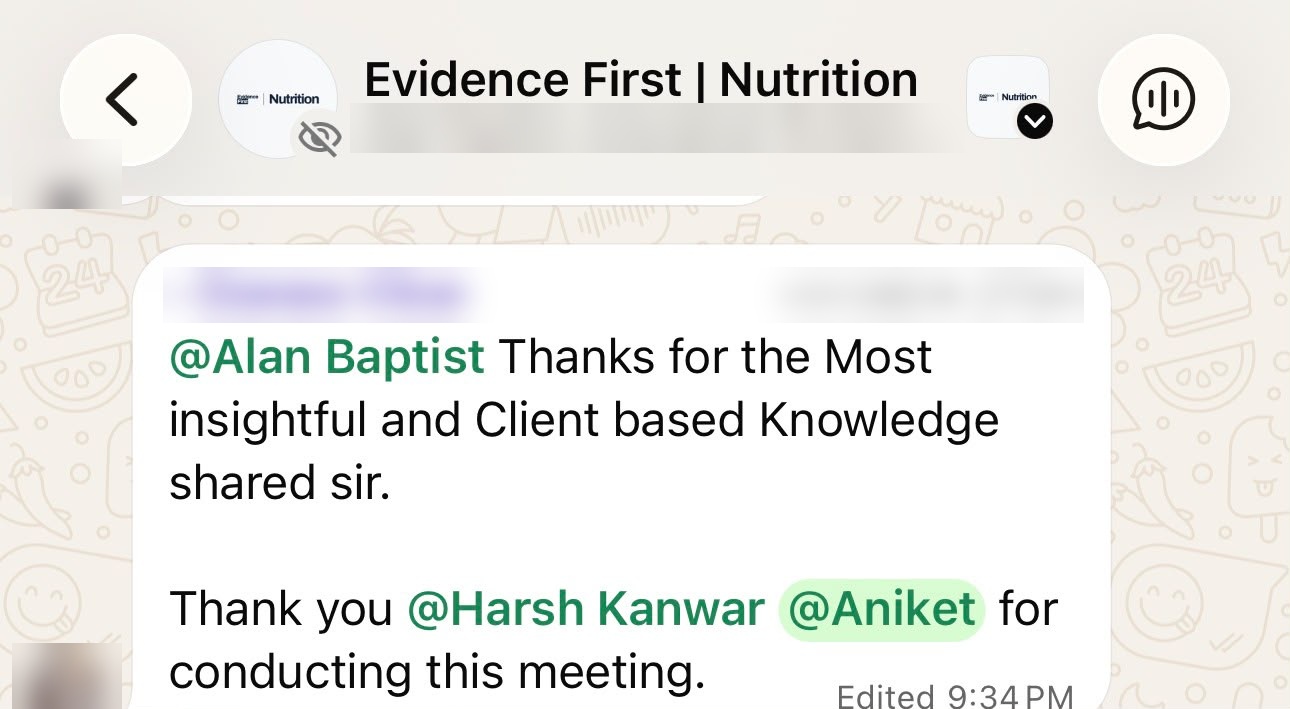
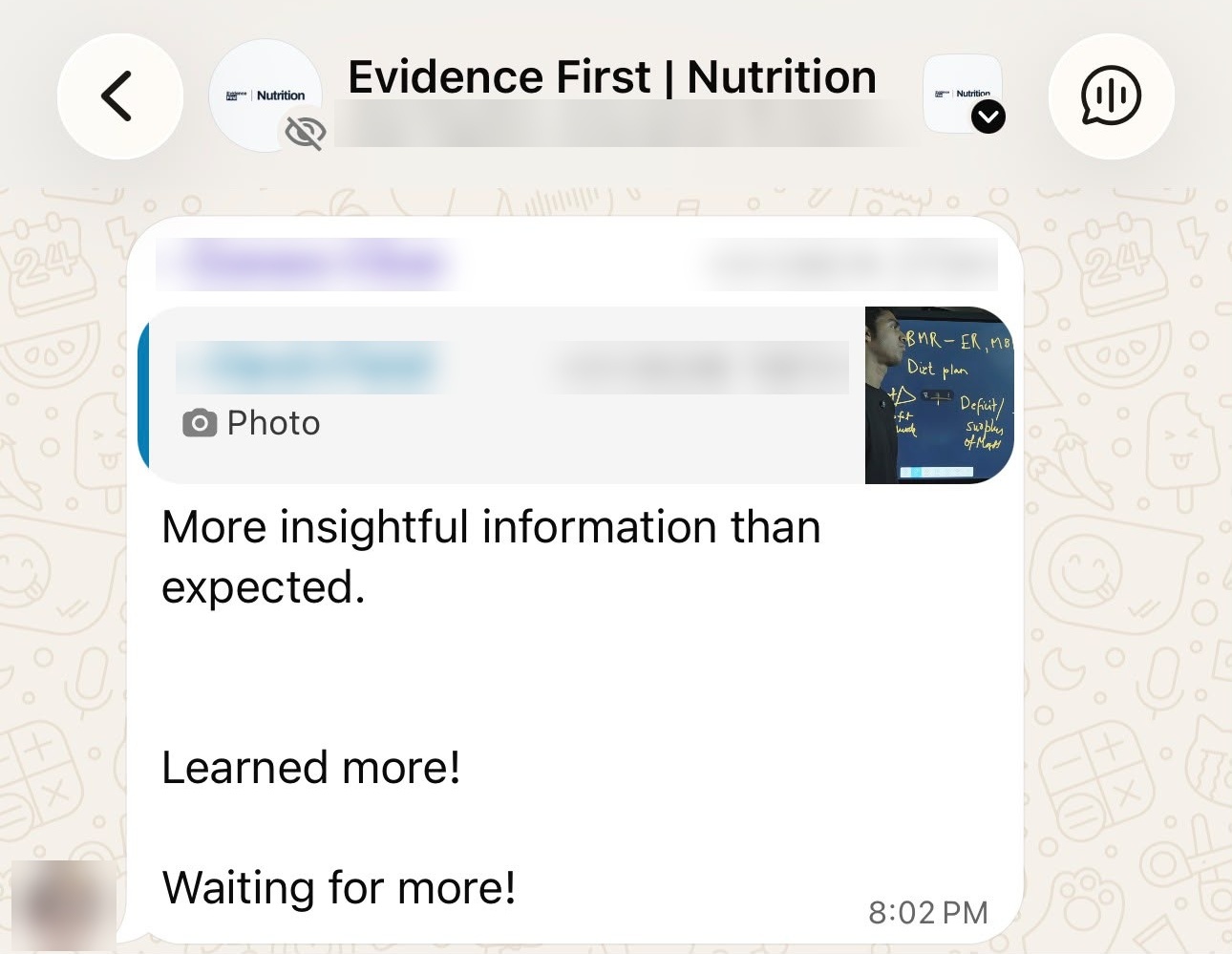
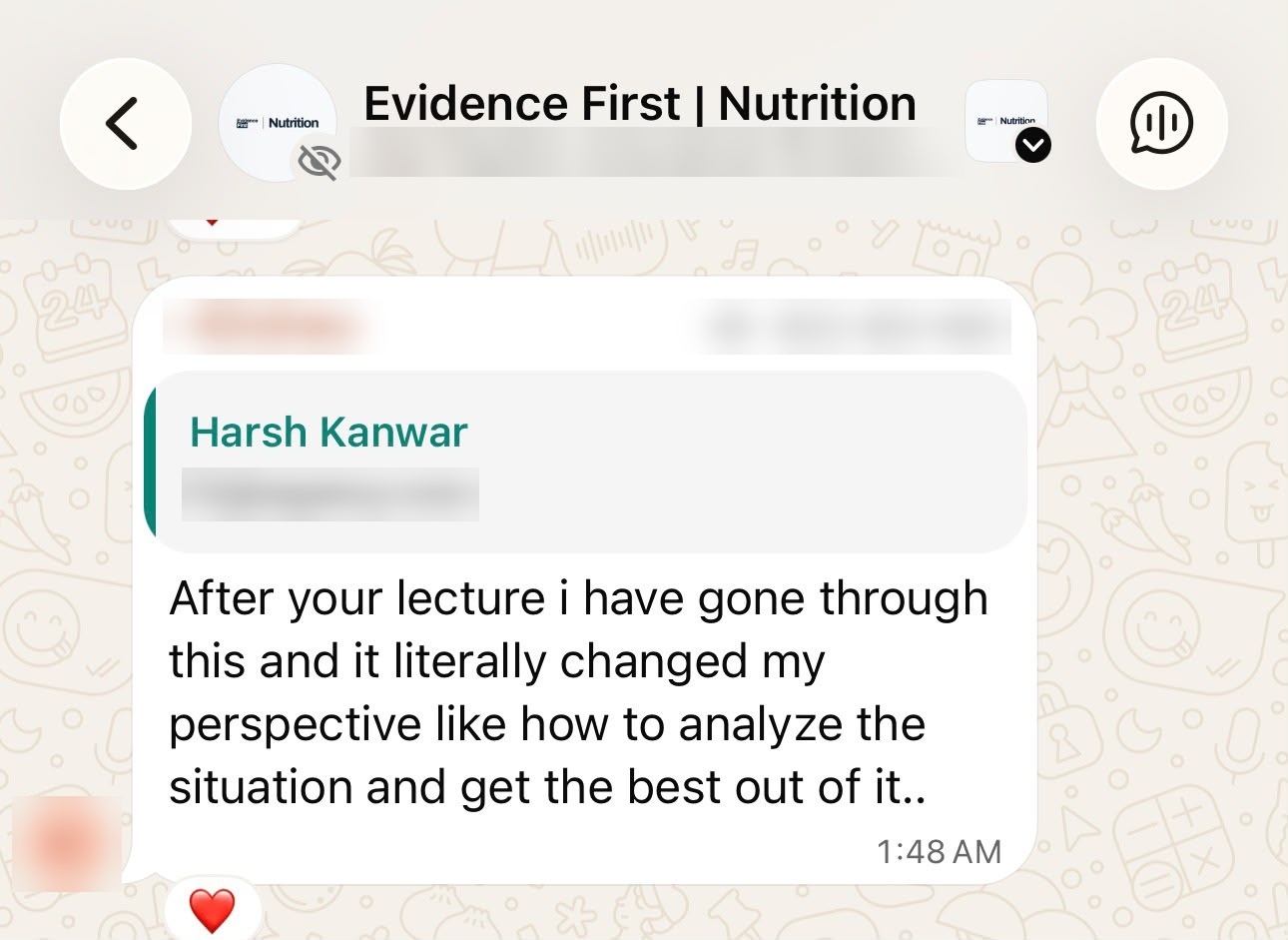
Join Evidence FirstWhat our students say
Swipe or use arrow keys to browse. Movement pauses while you browse and resumes afterwards.
Reviews

What’s included
- Evidence First live lectures, 1:1 client reviews, Q&A sessions and growth mentorshipValue ₹90,000
- Blood marker analysis and medical nutrition masteryValue ₹40,000
- Research reviewer and supplementation modulesValue ₹25,000
- Client case breakdown sessions and practical programming modulesValue ₹40,000
- Evidence-based nutritionist certificate upon graduationValue ₹5,000
- Lifetime access to the Evidence First communityValue ₹10,000
Bonuses
- BonusPlug and Play Coaching Vault + Programming CheatsheetsValue ₹20,000
Save time with coaching resources and programming templates you can use immediately.
- BonusEvidence First AI coaching expertValue ₹15,000
Get help with nutrition planning and everyday coaching questions.
- BonusFast-access lecture bitesValue ₹10,000
Review key concepts quickly, even when you only have a few minutes.
- BonusEvidence First Scale: Money and Reputation modulesValue ₹1,00,000
Learn to attract clients, price your services and build your reputation.
- Total programme value
- ₹3,55,000
- Our price
- See current fee
Scholarship price
Loading current fee…50% scholarship for the first 15 admissions.
For the 6-month course.
Credit card EMI available on eligible cards.
Course curriculum
01Start Here
- How nutrition claims become accepted facts, who funds the research and how funding can affect it
- The supplement industry in India: regulation, labels and ownership
- Getting your first 10 clients: outreach, early offers and onboarding each client as a case study
- Where a coach’s professional scope ends in India
02The Science Breakdown
- Where lost fat physically goes and the mass balance framework
- DEXA, BIA and skinfolds: measurement error and when a change is large enough to be meaningful
- Protein turnover, DIAAS and planning protein for vegetarian clients
- Carbohydrate and fat sources: rice, roti, millets, ghee, mustard, coconut and refined oils
- The evidence on sugar, seed oils and dietary cholesterol
- The four-step method for tracking food in grams
03Metabolism
- BMR, the thermic effect of food, activity and NEAT: what each contributes to energy expenditure
- Measuring energy expenditure and the limitations of calculators and wearables
- Adaptive thermogenesis and changes in NEAT: why a calorie deficit can stop working
- Leptin, ghrelin and the gut-brain axis: understanding appetite beyond willpower
- Clock genes, eating windows and coaching clients who work shifts
04When Metabolism Breaks
- Insulin signalling: what insulin does inside a cell
- Insulin resistance: tissue-specific mechanisms and their practical implications
- Thyroid function: what it controls and what is wrongly attributed to it
- The shared processes behind metabolic syndrome and fatty liver
- Chronic inflammation: separating markers, mechanisms and marketing claims
- Weight regain and disordered eating: recognition, professional scope and referral
05Gut Physiology
- Coeliac disease, gluten sensitivity and why a client may feel better after removing gluten
- Lactose, A1 versus A2 milk and claims about dairy and mucus
- The gut microbiome and IBS: what a coach can address and when to refer
06Supplementation
- Bioavailability, nutrient antagonists and the food matrix
- Creatine, caffeine, protein, vitamin D and omega-3: dosage, timing and whom the evidence applies to
- Contamination and label accuracy in the Indian supplement market
07The Build
- Estimating requirements: equations, their error margins and working back from actual food intake
- Gram tracking versus calorie tracking: when to use each and how to run both
- Setting targets in grams: protein first, a minimum fat intake and carbohydrates for the remainder
- Ultra-processed food and sweeteners: what trials and regulators have concluded
- Diet breaks, refeeds and mini-cuts: decision rules for choosing an approach
08Adherence & Psychology
- Motivational interviewing, with scripts for five common client statements
- How sleep restriction affects food intake and adherence
- The compliance interview: finding out what a client actually ate
- Check-ins that reveal when a client is struggling to follow the plan
- Recognising disengagement early and reconnecting with clients who stop responding
09Practical Application
- Low-carbohydrate, fasting, plant-based and detox diets: reviewing the evidence for each
- Regional Indian diets, religious fasting and planning around a real grocery budget
- Female clients, PCOS, thyroid conditions and GLP-1 use: when to adapt and when to refer
10Evidence
- What different study designs can and cannot establish, including limitations in fitness research
- How graphs can mislead: truncated axes, error bars and relative versus absolute risk
- Reading a paper from start to finish and comparing the abstract’s claims with the actual data
11Judgement
- Professional scope, red flags, referral and writing a referral note
- Client agreements, informed consent and handling health data
- Raising your rates with existing clients
- Recognising markers on a standard blood panel without moving into clinical interpretation
- What makes a passing client case and what examiners assess in the viva
12Medical Nutrition
- PCOS and thyroid conditions: what can be adapted within your professional scope
- Clients using GLP-1 medication: supporting behaviour change and addressing concerns about lean mass
- Reading a standard blood panel and recognising three common patterns
- The menstrual cycle, contraception and adjustments across the month
- Pregnancy, postpartum and clinical red flags: where coaching stops
- Older adults and adolescents: how nutritional requirements change
- Scope, referral and communicating with a client’s doctor without overstepping
13Money and Reputation
- Pricing your services and avoiding unsustainable rates
- Finding your first 10 paying clients: where to look and what to say
- Creating content that attracts clients as well as likes
- Building a professional reputation so prospective clients already trust your work
- Retaining clients beyond the first three months
Common questions
Who is this course for?
Coaches, doctors, dietitians and health professionals who want to deepen their nutrition knowledge through evidence-based learning.
I already have a certification. Is this useful for me?
Yes. Build on it by working through client plateaus, weight regain, supplement questions, viral claims and the practical constraints of Indian clients, with live case reviews.
Do I need to have clients already?
No. The business module covers finding your first 10 clients, outreach and onboarding. You can then apply what you learn to those cases.
Are the classes recorded or live?
Both. All recorded course modules unlock at once. Live lectures are also recorded and available on the platform afterwards.
How do I get personalised feedback?
Join the live Q&A calls and client case reviews. Bring a real client case, a question or a nutrition claim you want to work through.
How much time should I set aside?
Two to four hours a week, or about 30 minutes a day. Study the recorded modules around your schedule.
Who teaches the course?
Lecturers with PhDs, medical doctors and nutritionists with master’s degrees. The science modules are taught by people who work in the field.
What language is it taught in?
English, with captions on the videos.
Do I get a certificate?
Yes. You receive an evidence-based nutritionist certificate after meeting the course’s eligibility and assessment requirements.